Blog
Rectangular Prism Examples
Worked examples show how the same formulas appear in class exercises, cartons, and simple construction models.
By Rectangular Prism Calculator

Blog
Worked examples show how the same formulas appear in class exercises, cartons, and simple construction models.
By Rectangular Prism Calculator
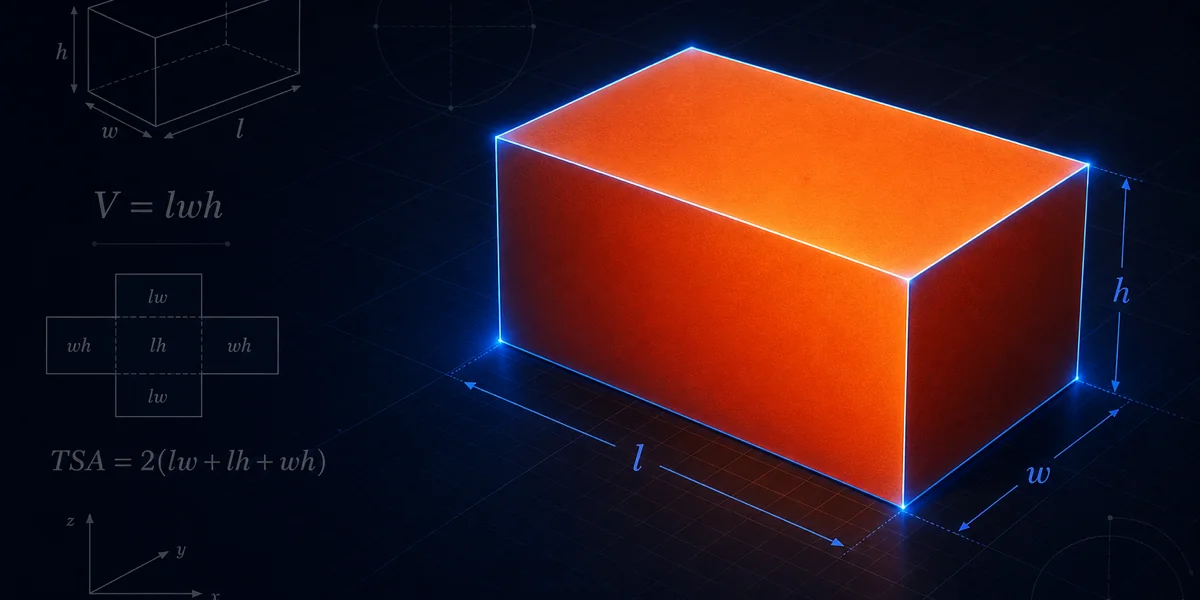
Apply V = lwh and TSA = 2(lw + lh + wh) after labeling edges on a sketch.
Formula
Rectangular Prism Calculator helps you calculate volume, surface area, and the space diagonal from length, width, and height.
Worked examples turn definitions into numbers you can repeat. They show formula choice, unit discipline, and intermediate lines instructors expect.
Use this page as a practice deck: read each prompt, sketch the box, solve on paper, then confirm with the home tool.
Change one edge at a time in the calculator to see how cubic and square results move together.
Examples bridge vocabulary to arithmetic. Each story tells you whether to target volume, total surface area, lateral area, or a diagonal before you substitute.
Geometry exercises often use clean integers. Packaging and construction stories may mix units or require a quick conversion at the start.
Showing face products lw, lh, and wh before doubling helps on surface area items even when a calculator will check the final number.
When a prompt asks only for capacity, study the dedicated volume of a rectangular prism guide for fill-specific wording and mistakes.
Convert units only at the start, not between multiplication steps mid-problem.
Label l, w, and h on a sketch before you touch a calculator keyboard.
For mixed prompts, solve volume and surface area in separate lines with separate units.
Space diagonal practice pairs with diagonal of a rectangular prism when you need face diagonal versus interior diagonal vocabulary.
Use this order for homework, site checks, packaging quotes, or classroom labs.
Problem: Three quick boxes with different targets:
Each item uses the same formula family with different givens and unit labels.
Practice a mix of volume-first, surface-area-first, and diagonal prompts until formula choice feels automatic.
Link back to formula and how-to articles when a new symbol or lateral area case appears.
Use the home calculator to build intuition about how results change when one edge changes.
Space diagonal of a rectangular prism with d = √(l² + w² + h²). Face vs interior diagonals, steps, and examples you can verify online.
Rectangular prism vs cube: equal vs unequal edges, formula shortcuts, volume and surface area comparisons, and misconceptions clarified.
Find a missing length, width, or height from volume or surface area. Reverse prism formulas, algebra steps, and forward-check tips.