Blog
Rectangular Prism Formulas
Volume, total surface area, lateral surface area, and the space diagonal share the same three edges. This article explains each formula and when to use it.
By Rectangular Prism Calculator

Blog
Volume, total surface area, lateral surface area, and the space diagonal share the same three edges. This article explains each formula and when to use it.
By Rectangular Prism Calculator
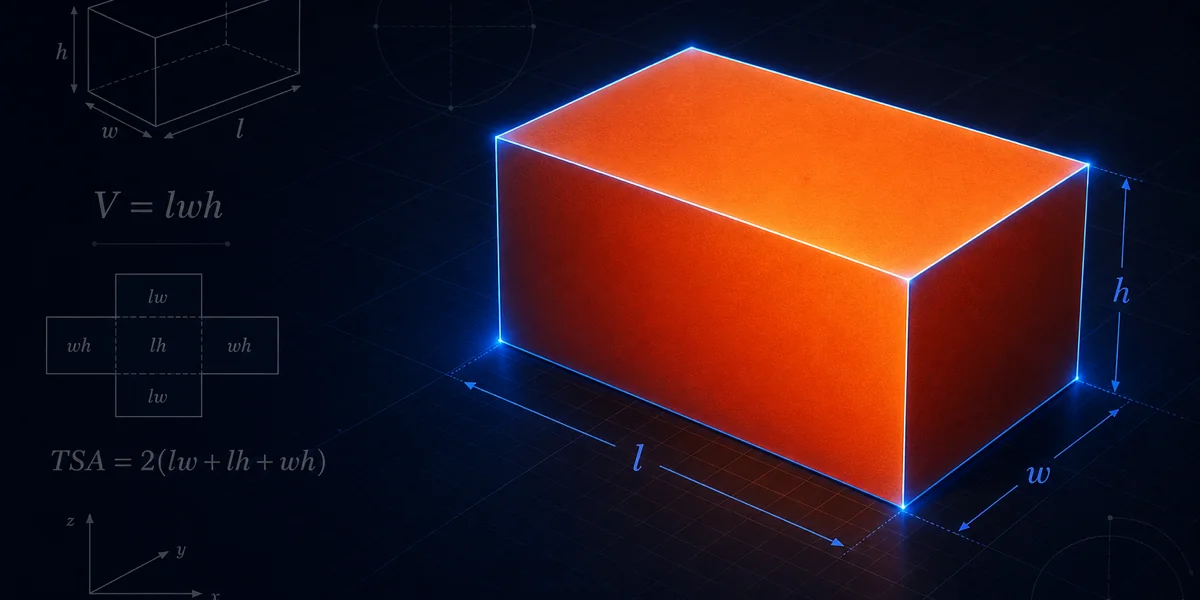
V = lwh, TSA = 2(lw + lh + wh), LSA = 2h(l + w), d = √(l² + w² + h²).
Formula
Rectangular Prism Calculator helps you calculate volume, surface area, and the space diagonal from length, width, and height.
Every result on the home page comes from the same three edge lengths. This article explains what each formula measures, when to use it, and how units must appear in the final answer.
Students often memorize four lines without knowing which question each line answers. The sections below tie symbols to everyday wording you will see in word problems.
If you have not yet defined the shape itself, read what is a rectangular prism first, then return here for the full formula set.
Each formula answers a different measurement question about the same box. Volume is cubic capacity inside the prism. Total surface area is the entire outer skin in square units. Lateral surface area skips the top and bottom faces when only the four walls matter.
The space diagonal runs through the interior between opposite corners and is longer than any single edge. It is not the same as a face diagonal drawn on one rectangle only.
All four standard formulas assume you have already labeled l, w, and h in one unit system. Converting one edge to inches while leaving another in centimeters will break every result, even if the algebra looks perfect.
Lateral surface area appears on label-wrap and wall-only tasks. Total surface area appears when paint, foil, or insulation must cover every face including top and bottom.
Volume multiplies the three perpendicular edges. Think of it as stacking a rectangular layer of area lw through height h, which is why cubic units appear.
Total surface area doubles the sum lw + lh + wh because each face type has a congruent opposite mate on the box. Adding the three products once, then doubling, is faster than listing six separate multiplications.
Lateral surface area 2h(l + w) counts only the four vertical walls when the problem excludes lids. Some textbooks write 2(l + w)h, which is identical.
Capacity questions in shipping and science labs lean on volume of a rectangular prism; wrap and paint estimates use total or lateral surface area from the same edge triple. Pick the target before you substitute numbers.
Use this order for homework, site checks, packaging quotes, or classroom labs.
Problem: l = 10 ft, w = 6 ft, h = 4 ft. Find V, TSA, LSA, and d.
Volume 240 ft³, total surface area 248 ft², lateral surface area 128 ft², space diagonal about 12.33 ft.
Keep the four formulas on a reference card and match each one to the words in the problem before you substitute.
Unit discipline matters as much as the algebra: square for area, cubic for volume, and one length unit for diagonals.
Use the home calculator to confirm arithmetic before you submit homework or order materials.
Space diagonal of a rectangular prism with d = √(l² + w² + h²). Face vs interior diagonals, steps, and examples you can verify online.
Rectangular prism vs cube: equal vs unequal edges, formula shortcuts, volume and surface area comparisons, and misconceptions clarified.
Rectangular prism examples with full volume, surface area, and diagonal solutions for geometry, shipping cartons, rooms, and cube cases.